
Golf shaft flex chart, decoded: the letters aren't standardized
Shaft flex letters L to X with swing speed ranges, torque and kick point in plain words, what a wrong shaft actually does, and the shafts LPGA pros really play.
I kept searching for the same shaft facts over and over. What SR means, how heavy a wedge shaft should be, whether my R flex was causing my miss. The answers were scattered across fitting sites, forum threads and manufacturer pages that don’t agree with each other.
So I collected the numbers in one place, with sources. This is the reference I wanted when I bought my first iron set: the flex chart, the vocabulary, the symptoms of a wrong shaft, and what shafts tour players actually use.
One warning up front, because it changes how you read everything below. The flex letters on the label are not standardized. Two shafts stamped R can play nothing alike.
Key Takeaways
- Flex letters run L, A (senior), R, SR, S, X from softest to stiffest. One common chart maps R to an 84-96 mph driver swing (Golf.com, 2020).
- There’s no industry standard behind those letters. A fitting expert at True Spec Golf calls them “essentially irrelevant” across brands (Golf.com, 2021).
- Weight in grams is printed on the same label and is directly comparable across brands. My own N.S. Pro 950GH R weighs 94.5 g; a Dynamic Gold R300 weighs 127 g (Nippon Shaft, True Temper, retrieved 2026-08-30).
- The “stiff shaft causes a slice” rule is shakier than it sounds. One controlled test found its only real slice-side miss with a stiff shaft, not a soft one (Plugged In Golf, 2016).
- In one analysis of the 2023 CME top 100, not a single LPGA player carried a ladies-flex driver shaft (Golfing Focus, retrieved 2026-08-30).
The flex chart: L, A, R, SR, S, X
Flex is the shaft’s resistance to bending during the swing. Softer flex for slower swings, stiffer flex for faster ones. The letters run in this order, from softest to stiffest:
| Letter | Usually called | Driver swing speed (one common chart) |
|---|---|---|
| L | Ladies | under 72 mph |
| A | Senior (also “Amateur” or M) | 72-83 mph |
| R | Regular | 84-96 mph |
| SR | Stiff Regular (between R and S) | between the R and S bands |
| S | Stiff | 97-104 mph |
| X | Extra Stiff | 105+ mph |
The mph bands come from True Spec Golf data published by Golf.com in June 2020 (Golf.com, retrieved 2026-08-30). SR sits between R and S and is common on Japanese-market shafts; the Golf.com chart doesn’t list it as a separate band.
Now the part most charts leave out. There is no governing body that defines what R or S must measure. Kris McCormack, VP of Tour and Education at True Spec Golf, put it bluntly: “there’s no industry standard for flex in a shaft. So one company’s ‘Stiff’ could be another company’s ‘X’” (Golf.com, Nov 2021, retrieved 2026-08-30).
So use the chart the way fitters use it: as a starting point inside one brand’s lineup. The letter tells you where a shaft sits among its own siblings. It can’t tell you how it compares to another brand’s letter.
If you don’t know your swing speed, you have two honest options. Many golf stores will put you on a launch monitor for free. Or use your average driver carry distance as a stand-in, which is what Callaway’s own fitting handbook does when speed is unknown (Callaway OPTIFIT Custom Fitting Handbook, 2024, retrieved 2026-08-30). Guessing from your height, weight or gender is not one of the options, and I’ll show why with tour data below.
The vocabulary: weight, torque, kick point
Three terms cover most of what a shaft label and spec sheet will throw at you.
Weight
Weight is the number I now check first, because grams are grams in every brand. A steel iron shaft can run from the mid-90s to over 130 g. Graphite driver shafts mostly sit in the 50-70 g range (Plugged In Golf, retrieved 2026-08-30).
Heavier shafts generally reward strength and aggressive tempo with control. Lighter shafts help you swing faster with less effort. Neither is better; they trade against each other.
Torque
Torque is how much the shaft twists around its own axis during the swing, measured in degrees. Picture wringing a towel: a low-torque shaft resists that wringing motion harder. Most shafts fall roughly between 2 and 7 degrees, and a lower number means less twisting (Golf.com, retrieved 2026-08-30).
The same Golf.com explainer notes that when torque is too high for a player’s speed, the face tends to hang open, producing a high, weak miss. Faster, harder-swinging players generally suit lower torque. Smoother tempos can use more of it.
Kick point
Kick point (or bend point) is where along its length the shaft bends most. A low kick point bends nearer the head and helps the ball climb. A high kick point bends nearer the grip and keeps flight down.
Manufacturers publish it as low, mid or high on the spec sheet. Nippon lists my 950GH as mid kick point, for example (Nippon Shaft, retrieved 2026-08-30). Treat it as a trajectory hint, not a promise.
What actually happens when the shaft is wrong
Here’s what fitters and equipment writers consistently describe, and where the folk wisdom overreaches.
A shaft that’s too stiff for your speed is commonly described as producing a low, flat flight that never quite climbs, lost carry distance, and a dead or board-like feel at impact. You can’t load it, so it never kicks back through the ball.
A shaft that’s too soft is described as the opposite problem: a high, ballooning flight that falls out of the sky, a whippy or mushy feel, and shots scattered in both directions because the timing of the kick keeps changing.
Notice what I didn’t say: stiff means slice, soft means hook. That’s the version every driving-range partner recites, and the evidence for it is thin. Shot shape is driven mainly by your swing path and where the face points at impact. The shaft is a secondary actor.
One controlled test makes the point. In 2016, Plugged In Golf put six golfers (handicap 10 to scratch) on Trackman with regular, stiff and extra-stiff versions of the same 6-iron shaft. The only substantial right-side miss in the whole group came with a stiff shaft. The softest shafts made testers “either very accurate or prone to hooking the ball” (Plugged In Golf, Oct 2016, retrieved 2026-08-30). The stereotype ran backwards.
So don’t buy a softer shaft to cure a slice. Fix the path and face first. Use flex to fix flight height, feel and dispersion.
How I picked mine: 950GH R to Modus3 Tour 105 R
My first irons were used Bridgestone V300s that came with an N.S. Pro 950GH R shaft. I didn’t choose that shaft. It was simply what the previous owner left in the heads, which is how most beginners meet their first shaft.
When I bought my first new set, I had to actually decide. I found a method online that picked iron shafts from driver ball speed, ran my numbers, and landed on the N.S. Pro Modus3 Tour 105 in R. Slightly heavier than the 950GH, same letter on the band.
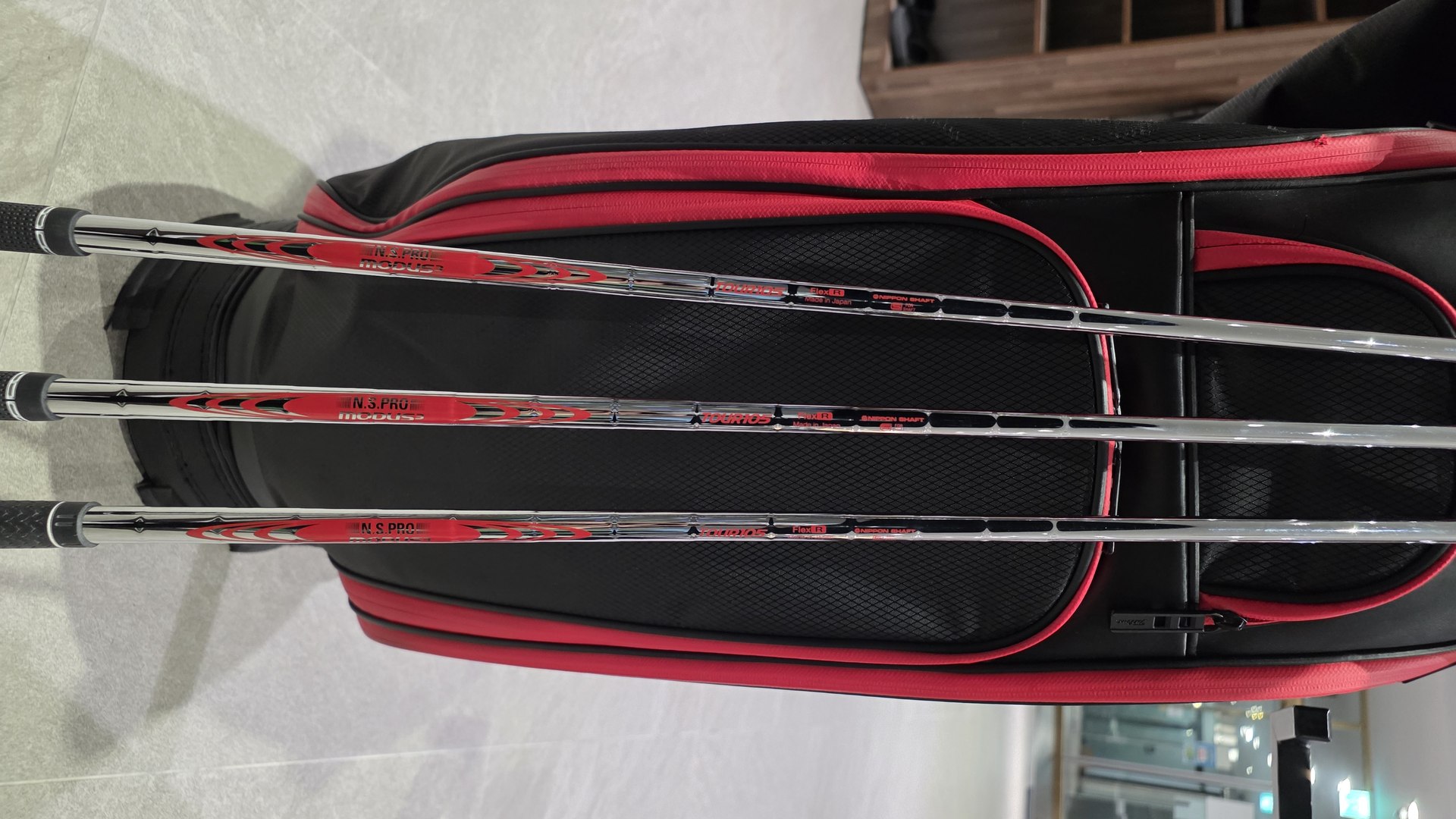
The band on my current irons. Tour 105, Flex R, and the gram count matters more than the letter.
Here’s what that move looked like in manufacturer numbers. The 950GH in R weighs 94.5 g with 2.0° torque. The Modus3 Tour 105 in R weighs 103 g with 1.9° torque (Nippon Shaft 950GH, Modus3 Tour 105, retrieved 2026-08-30). Same letter, 8.5 g apart, and I could feel the difference in tempo within a range session.
One honest correction to my own process. When I researched this article, I couldn’t find any manufacturer that publishes a ball-speed-to-flex chart. The speed-based charts that do exist, like the True Spec bands above, use swing speed, and Callaway’s handbook falls back to carry distance. My method pointed the same general direction, but I got a defensible answer partly by luck.
The four numbers on that chart also show why the letter alone misleads. Four R shafts span 94.5 to 127 g. That gap changes tempo, flight and feel far more than most people expect from “the same flex.”
How weight flows through the bag
Look in any bag, including mine, and the shafts get heavier as the clubs get shorter. This is deliberate, and it’s the part of shaft setup beginners hear about last.
The convention fitters’ guides describe runs in roughly 10-gram steps: driver lightest, fairway woods a step up, hybrids another step, then irons, then wedges heaviest (D’Lance Golf, Plugged In Golf, retrieved 2026-08-30). Longer clubs get lighter shafts so you can generate speed. Shorter clubs get heavier shafts because control matters more than distance there.
The practical rule is smoothness. If your driver shaft is 55 g and your irons are 130 g, each club in between should step up gradually rather than jump. When one club feels alien in an otherwise comfortable bag, an abrupt weight jump is a common suspect.
What “wedge flex” means
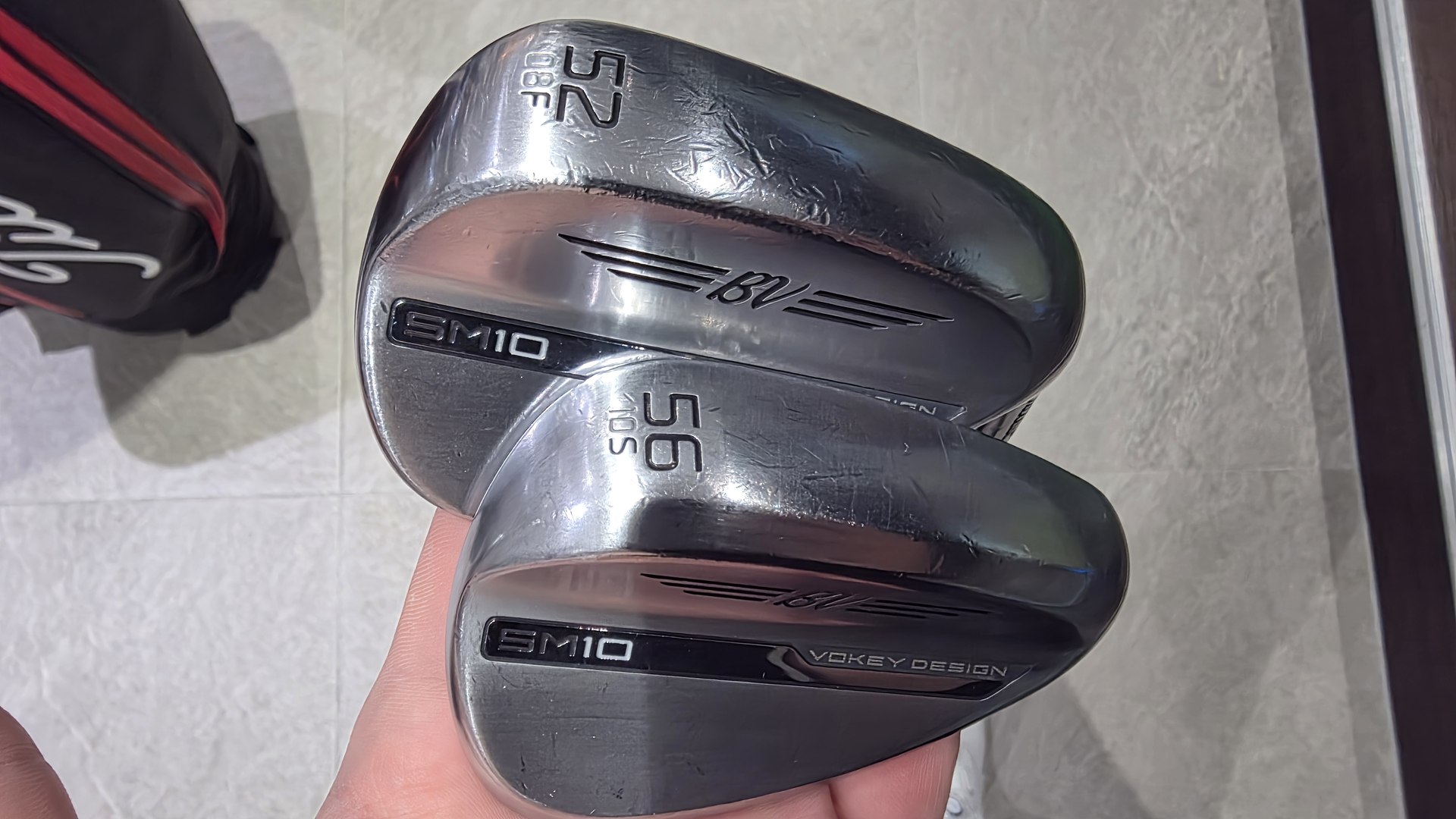
My SM10 wedges say nothing like R or S. Stock Vokey wedges ship with the True Temper Dynamic Gold S200 as the standard shaft, and that’s what the market sells as wedge flex (Titleist, retrieved 2026-08-30).
How heavy is it? Here the two manufacturers’ own pages disagree. True Temper lists the S200 at 127 g (True Temper, retrieved 2026-08-30), while Titleist’s SM10 spec table lists the same shaft at 130 g. Either way it’s among the heaviest shafts in the bag, and nobody publishes an explanation for the 3-gram gap.
So wedge flex isn’t a softer secret category. It’s a heavy, stiff-family shaft chosen because wedges are swung with partial, control-first motions. If your iron shafts are very light, some fitters will match your wedges to them instead; that’s a fitting conversation, not a rule.
The shafts you’ll actually run into
You don’t need to know fifty shafts. These families cover most racks and most used-market listings.
Iron shafts (steel)
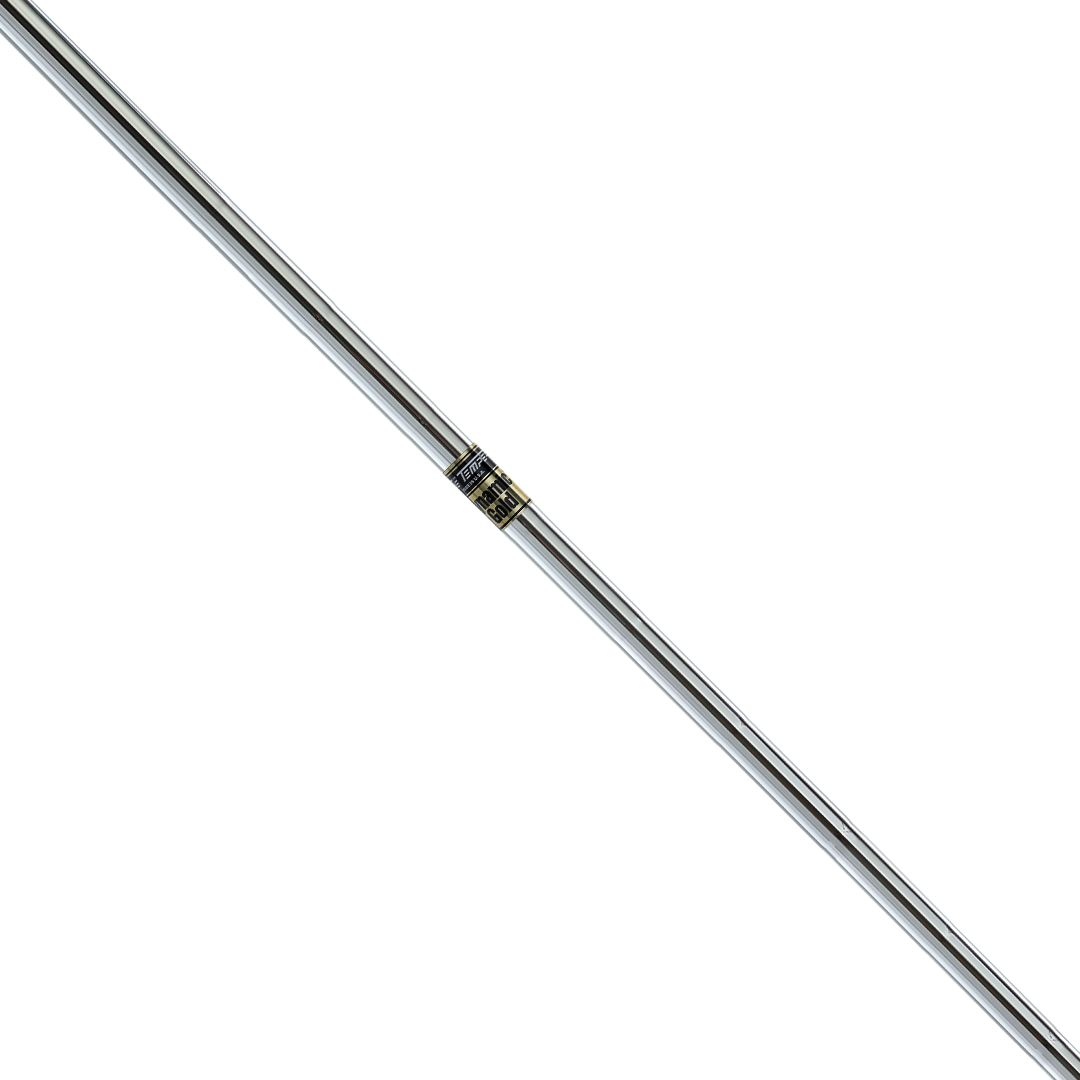
Photo: True Temper official product page.
True Temper Dynamic Gold is the classic heavy tour shaft, with a low-launch bias. True Temper lists R300 at 127 g, S300 at 130 g and X100 at 130 g (True Temper, retrieved 2026-08-30). If you see a used players-iron set, odds are decent it carries one of these.
N.S. Pro 950GH is the opposite pole: 94.5 g in R, marketed as steel light enough to rival graphite (Nippon Shaft, retrieved 2026-08-30). It’s everywhere in off-the-rack game-improvement sets, which is exactly how mine arrived.
N.S. Pro Modus3 is Nippon’s tour family. The number is the approximate weight class: Tour 105 at 103 g in R, Tour 115 at 117.5 g in R, on up through Tour 130 (Nippon Shaft Tour 105, Tour 115, retrieved 2026-08-30).
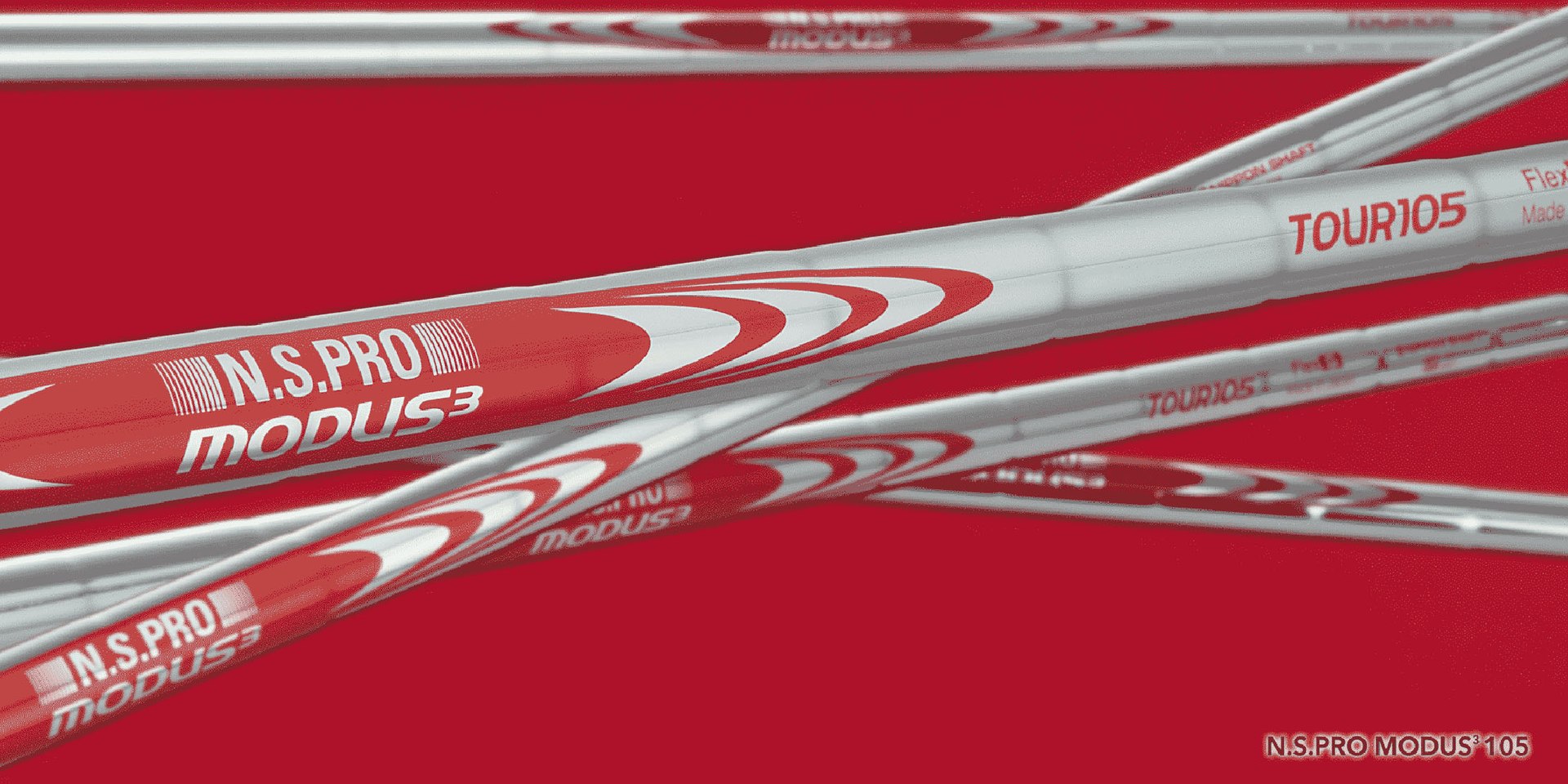
Photo: Nippon Shaft official product page. This is the family my own irons came from.
KBS Tour and Project X round out the names you’ll hear. KBS positions its Tour line as mid launch and spin; Project X is known for a low, stable, anti-spin profile. Both publish weights per flex on their own pages, and the numbers land between the 950GH and Dynamic Gold poles.
Driver and wood shafts (graphite)
Fujikura Ventus dominates recent conversation. The colors are launch profiles, not cosmetics: Black is lowest launch and spin for aggressive swingers, Blue is the mid option, Red launches highest and forgives most (Golf.com, retrieved 2026-08-30).
Mitsubishi (Tensei, Diamana, Kai’li) and Graphite Design Tour AD are the other two families worth recognizing on a rack or a tour bag. Within each, sub-models split along the same launch-and-spin axis as Ventus colors. The lesson repeats: within one family, the variant name tells you the flight bias.
The stock shaft asterisk
The shaft that comes installed in an off-the-rack driver is often a made-for version: same brand graphics as the aftermarket shaft, different construction. Golf.com’s equipment desk, quoting a shaft-industry product officer, describes stock versions as using lower-grade materials and looser tolerances than their $200-plus aftermarket namesakes (Golf.com, retrieved 2026-08-30). Torque often runs a degree or two higher too, per the same report.
Plugged In Golf’s own test pushed back a little, finding the practical gap small for average swingers (Plugged In Golf, retrieved 2026-08-30). My takeaway sits between them. Don’t assume the Ventus in a stock driver is the Ventus a tour pro plays, and don’t panic about it either.
What LPGA pros actually play, including two Koreans
If flex followed gender, the LPGA would be wall-to-wall L flex. It is nothing of the sort, and the tour data is the cleanest argument against picking shafts by demographic.
One analysis of the 2023 CME top 100 found 78% of surveyed drivers in stiff, 16% in regular, a few in X, and zero in ladies flex. Irons told the same story: mostly stiff, a third regular, zero L (Golfing Focus, 2023-season data, retrieved 2026-08-30). Trackman’s tour averages put LPGA driver club speed at 96 mph (Trackman, retrieved 2026-08-30), which sits right on the chart’s R-to-S boundary. The letters follow the speed.
Here’s what documented bags looked like, with dates, because tour setups churn:
| Player | Driver shaft | Iron shafts | As of |
|---|---|---|---|
| Nelly Korda | Graphite Design Tour AD FI 6 S | Aerotech SteelFiber i80cw (graphite, ~80 g) | Jun 2026 (NCG) |
| Charley Hull | UST Mamiya Attas 6Star 6 X | N.S. Pro Modus3 Tour 125 S (128.5 g steel per Nippon Shaft) | Apr 2026 (NCG) |
| Lydia Ko | Mitsubishi Diamana PD 50 S (50 g) | Aerotech SteelFiber fc70 S (graphite, ~70 g) | Aug 2024 (Golf.com) |
| Jin Young Ko | — (free agent, setup in flux) | Bridgestone tour protos with Aerotech SteelFiber | Aug 2024 (NCG) |
| Hyo Joo Kim | Yonex REXIS KAIZA-M 6 S | N.S. Pro Zelos (lightweight steel) | Aug 2024 (NCG) |
Charley Hull’s irons deserve a second look: 128.5-gram stiff steel, about 25 g heavier than the shaft in my own irons. Lydia Ko wins majors with a 50-gram driver shaft, in stiff. Same tour, same trophy case, nearly an 80-gram spread between their setups. Speed and delivery pick the shaft. Demographics don’t.
Two more Koreans worth tracking recently moved from the KLPGA to the LPGA. In her 2024 KLPGA season, Ina Yoon played a Ventus Blue 6 S driver shaft with Modus3 105 S irons (Golf Issue, Apr 2024). She then switched her whole bag to TaylorMade for the 2025 move to the US (Seoul Shinmun, Feb 2025), and her current shaft specs haven’t been published anywhere I could verify.
Youmin Hwang’s early-2024 bag ran a Ventus Black 5 S driver shaft and, in the irons, the N.S. Pro 950 in R (Sports World TV, Jan 2024). Read that again: an LPGA winner’s iron shaft, same model and flex as the one in thousands of beginner sets, including my old V300s. Her current Callaway setup’s shafts are likewise unpublished, which says something about how thinly women’s tour equipment gets covered.
The women’s-tour caveat matters for this whole table. LPGA winner’s-bag coverage rarely records shafts, so several rows above are the newest data that exists, not this week’s setup.
Golf Monthly’s advice column reaches the conclusion the data supports: there’s no one-size women’s shaft, because “the club doesn’t know who is using it” (Golf Monthly, Feb 2023, retrieved 2026-08-30). One veteran fitter reports fitting women into shafts from 45 to 125 g, with fewer than 10% of properly fitted women landing in a standard ladies shaft (True Fit Clubs, May 2019, retrieved 2026-08-30).
Frequently asked questions
What flex should I start with if I’ve never been measured?
Get one number first: driver swing speed from a store launch monitor, or your honest average carry. Then find your band in the L-to-X flex table at the top of this article, and apply it within a single brand. If you’re between letters, a softer shaft you can load usually beats a stiffer one you can’t.
Is my slice the shaft’s fault?
Probably not. Slices come mostly from swing path and an open face, and the one controlled flex test on record saw its clearest slice-side miss with a stiff shaft, not a soft one (Plugged In Golf, 2016). Change the shaft to fix height, feel and consistency, and take lessons to fix the curve.
Are ladies shafts only for women?
No, in both directions. They’re simply the lightest, softest flex band, right for anyone swinging under roughly 72 mph. Meanwhile zero of the surveyed 2023 CME top-100 LPGA players used them, so plenty of women are wrongly down-flexed by the label (Golfing Focus, retrieved 2026-08-30).
What does the SR on Japanese shafts mean?
Stiff Regular: a half-step between R and S. Japanese brands like Nippon slice the flex range more finely, which is genuinely useful once you’ve noticed that brand letters aren’t standardized anyway.
Do I need to replace the stock shaft in a new driver?
Not by default. Stock and aftermarket versions of the same shaft can differ in build, but a test on average swingers found the practical gap small (Plugged In Golf, retrieved 2026-08-30). Spend on a fitting before you spend on an upgrade.
The short version
The flex letter is a within-brand sorting label, not a measurement. The gram number is a measurement. When you compare two shafts, compare the grams and the torque, note the kick point, and treat the letter as a tiebreaker.
And when someone tells you what flex you must play because of your age, size or gender, remember the tour table above. A major champion plays 50-gram stiff. An LPGA winner irons the same shaft as a beginner set. Speed decides; labels follow.
If you’re weighing a specific iron purchase, I walked through my own spec-by-spec decision between generations of one iron model in my T100 loft chart article, which pairs well with this one.