
Titleist T100 lofts didn't change for three generations. Then 2025 moved all of them.
Identical T100 lofts from 2019 to 2023, then one degree stronger in 2025. Full loft, lie and length chart, plus why the T100 and T150 gap halved.
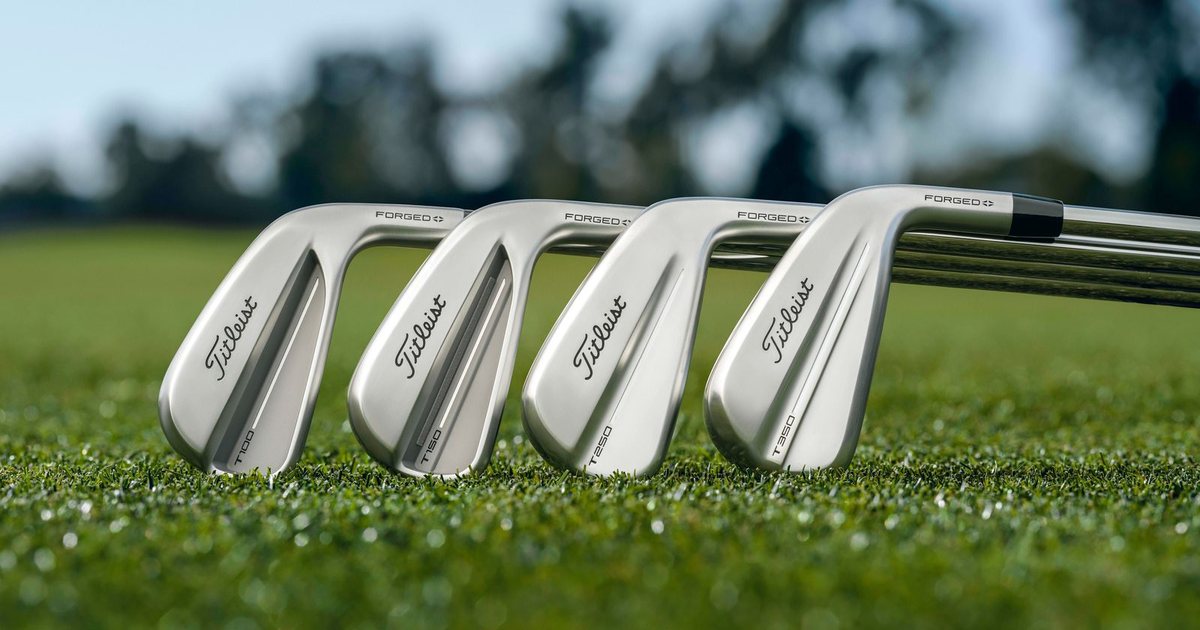
I look up T100 lofts more often than I’d like to admit. Every time, I end up on a spec page that doesn’t say which model year it covers. So I pulled the numbers from Titleist’s own spec tables for all four releases and put them in one place.
The short version: the 2019, 2021 and 2023 T100 sets share exactly the same lofts. The 2025 set is one degree stronger in every club. Lengths never moved at all. Lie angles moved once, in 2021, and only in the two longest irons.
Key Takeaways
- T100 lofts were identical across the 2019, 2021 and 2023 releases: 21° in the 3-iron through 46° in the P and 50° in the W (Titleist, retrieved 2026-08-29).
- The 2025 set is one degree stronger in every club, from 20° in the 3-iron to 45° in the P (Titleist, retrieved 2026-08-29).
- Because the whole set moved together, gapping between clubs is unchanged. Only the absolute number on each head is different.
- The stamp on your P tells you which era you own. 46° means 2019, 2021 or 2023. 45° means 2025.
- T100S, and then T150 after it, sat exactly two degrees stronger than T100 through the 2023 release. The 2025 loft change cut that to one degree, because T100 moved and T150 didn’t.
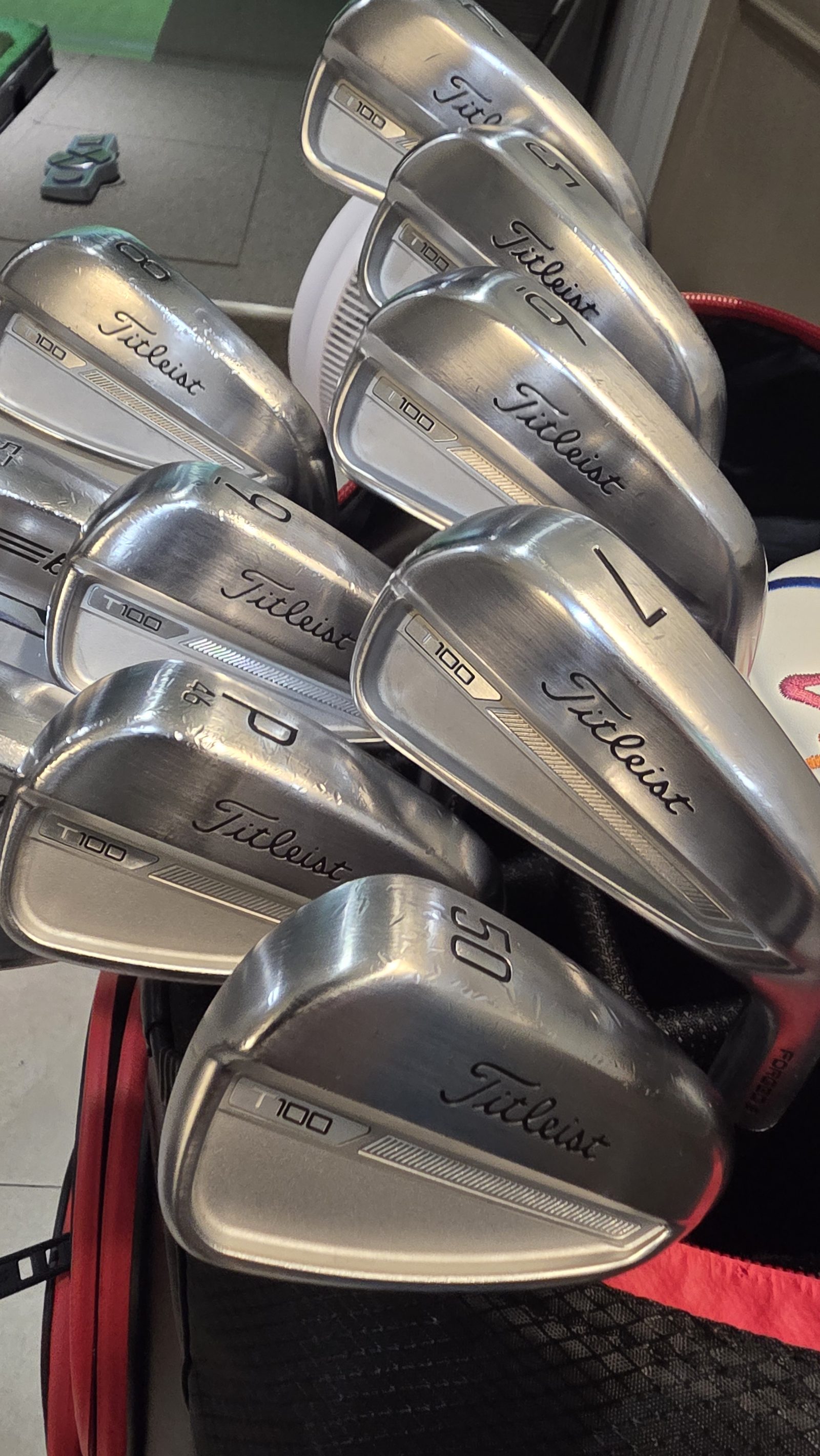
My own set, 2023 T100. The P reads 46 and the W reads 50, which is what the spec table below predicts for that generation.
The complete T100 loft chart, 2019 to 2025
Every number here comes from Titleist’s own spec tables, including the archived pages for the older releases. Titleist doesn’t use generation numbers, so I’ve labeled the rows by release year.
| Club | 2019 | 2021 | 2023 | 2025 |
|---|---|---|---|---|
| 3 | 21° | 21° | 21° | 20° |
| 4 | 24° | 24° | 24° | 23° |
| 5 | 27° | 27° | 27° | 26° |
| 6 | 30° | 30° | 30° | 29° |
| 7 | 34° | 34° | 34° | 33° |
| 8 | 38° | 38° | 38° | 37° |
| 9 | 42° | 42° | 42° | 41° |
| P | 46° | 46° | 46° | 45° |
| W | 50° | 50° | 50° | 49° |
Sources: Titleist spec tables for 2019, 2021, 2023 and 2025, all retrieved 2026-08-29. Titleist’s 2025 launch release lists the same figures (Titleist Newsroom, July 10, 2025).
That parallel shift is the part worth holding onto. A stronger loft on its own tells you nothing about gapping. Since every club moved by the same amount, the 2025 set steps through the bag exactly like the 2023 set does.
Plugged In Golf reached the same conclusion after testing, calling the difference for anyone upgrading from 2023 a marginal one in yardage (Plugged In Golf, updated October 9, 2025).
Lie angle changed once. Length never did.
Loft gets all the attention, so this one is easy to miss. The 2019 T100 had a 60° lie in the 3-iron and 61° in the 4-iron. From 2021 onward, those became 61° and 61.5°.
Length is the one spec that never moved at all, so I’ve put it in the same table.
| Club | Lie, 2019 | Lie, 2021 onward | Length, all four releases |
|---|---|---|---|
| 3 | 60° | 61° | 39.00” |
| 4 | 61° | 61.5° | 38.50” |
| 5 | 62° | 62° | 38.00” |
| 6 | 62.5° | 62.5° | 37.50” |
| 7 | 63° | 63° | 37.00” |
| 8 | 63.5° | 63.5° | 36.50” |
| 9 | 64° | 64° | 36.00” |
| P | 64° | 64° | 35.75” |
| W | 64° | 64° | 35.50” |
Sources: Titleist spec tables for 2019, 2021, 2023 and 2025, all retrieved 2026-08-29. Each of those pages gives one lie row and one length row for the whole lineup. The same figures apply to the other models sold that year.
This matters if you’re buying a single replacement club used. A 2019 3-iron dropped into a 2021 set is a degree flatter than its neighbors. That is a real difference, though a fitter can bend it.
What actually changed in each generation
Since the numbers barely move, the differences live in construction and shape. Here is what Titleist claimed at each launch. I’m reporting the manufacturer’s own description, not testing it.
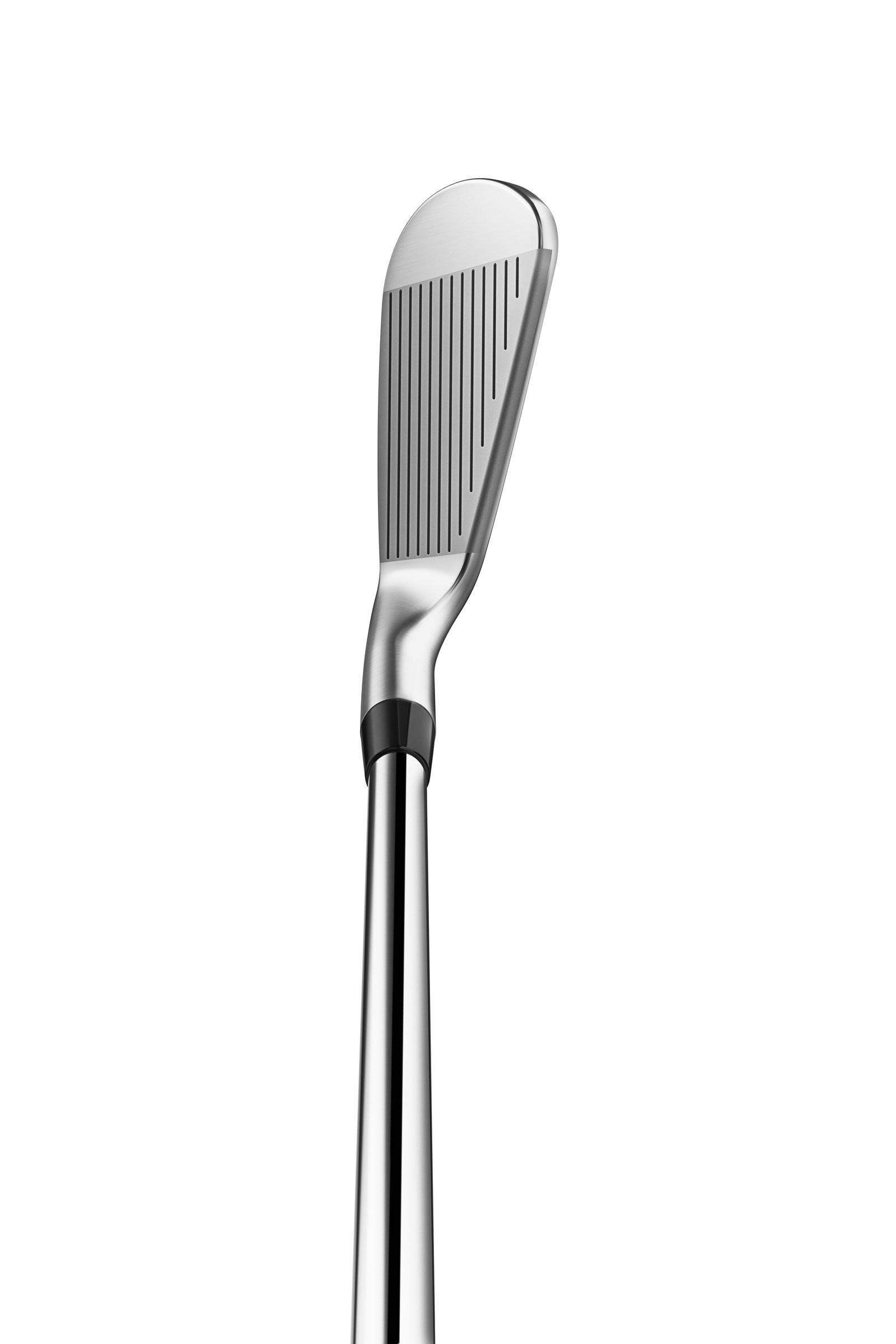
The address profile Titleist sells the T100 on: thin topline, short blade, almost no offset. Image from the Titleist media center.
2019: the AP2 replacement
The first T100 arrived in August 2019, retiring the AP2 line. It introduced the fully forged dual cavity body, with high density tungsten in the heel and toe of the mid and long irons to control the center of gravity (Titleist, retrieved 2026-08-29).
2021: better tungsten, new sole, new finish
Titleist moved to denser D18 tungsten and a 2000°F aerospace brazing process that removes weld points. On Titleist’s account, that let engineers place the center of gravity more precisely. This release also brought the variable bounce sole, with less bounce in the heel and more in the toe, plus a brushed chrome finish meant to cut glare (Titleist Newsroom, July 29, 2021).
The 4-iron through 7-iron faces were also redesigned to add a little spin. This is the release where the long iron lie angles changed.
2023: refinement, not redesign
The 2023 set kept the same construction. Titleist added a thicker back bar, a CNC milled face, and a trailing edge smoothed with input from the Vokey grind team, all aimed at feel and turf interaction. Golf.com described it as subtle refinement rather than a rework (Golf.com, August 3, 2023).
This is also the release where T100S left the lineup and T150 took its place.
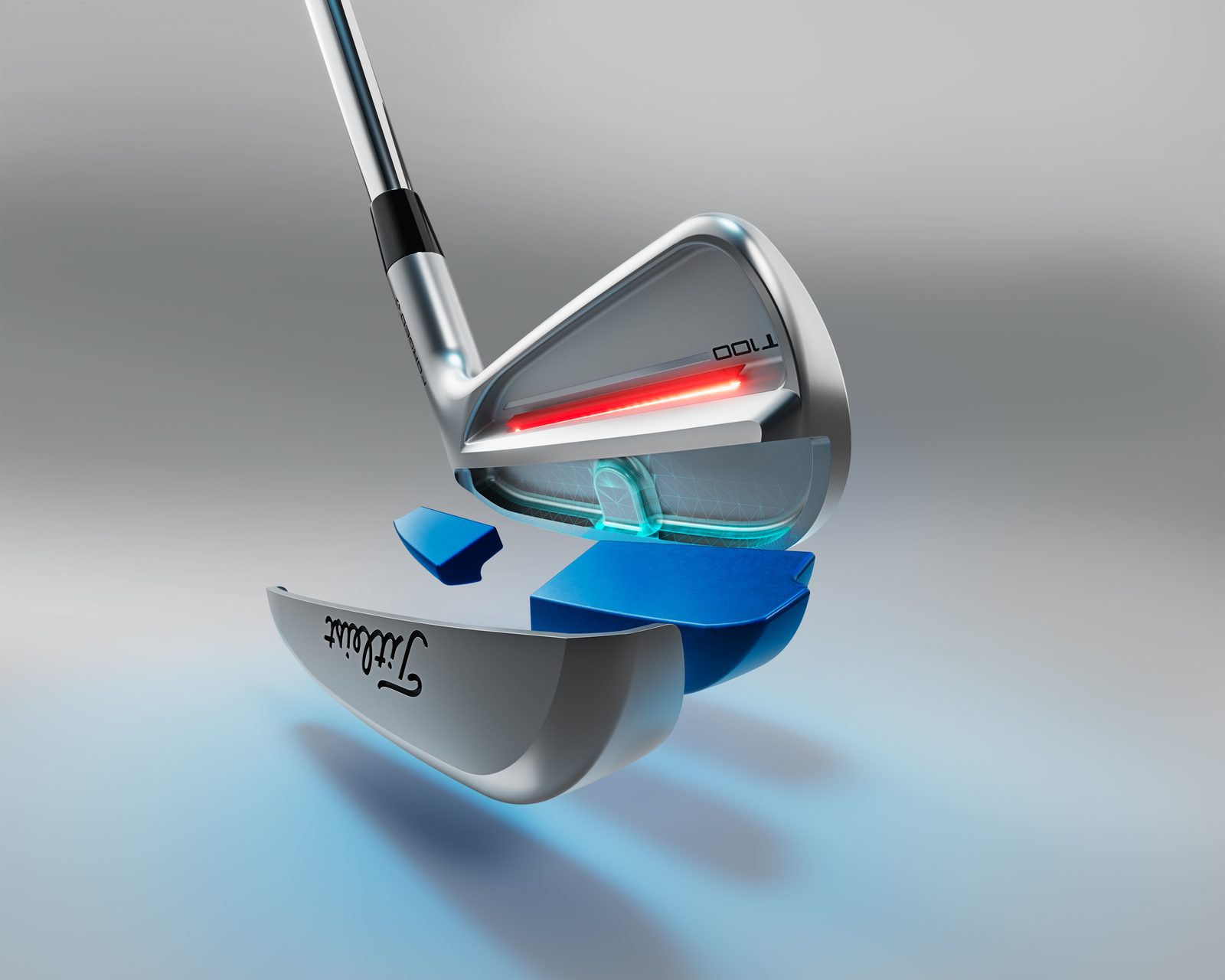
The 2025 construction, as Titleist illustrates it. Image from the Titleist media center.
2025: the first loft change
The current set is the only one that moved the numbers. Alongside the one degree of loft, Titleist added a muscle channel to the 3-iron and 4-iron to lower the center of gravity and raise peak height. It also added variable face thickness in the 3-iron through 7-iron, plus more aggressive grooves in the mid and short irons (Titleist Newsroom, July 10, 2025).
The two accounts of why the lofts moved don’t line up, and that’s worth noticing. Titleist’s own launch release frames the change around launch height and carry consistency, not distance. Plugged In Golf, reporting on the same release, says the goal was slightly more distance for Titleist’s LPGA players (Plugged In Golf, updated October 9, 2025).
I can’t settle which is right, and I don’t think the gap is an accident. “Stronger lofts” reads as a distance grab to the exact audience this iron is sold to, so the manufacturer has a reason to lead with trajectory. Either way, the set moved as a block, so the practical result is the same.
Where T100 sits in the T-Series lineup
The generation question and the model question get tangled together constantly, so here is the current lineup side by side. All four 2025 models share the same lie and length progression. What separates them is loft, size and construction.
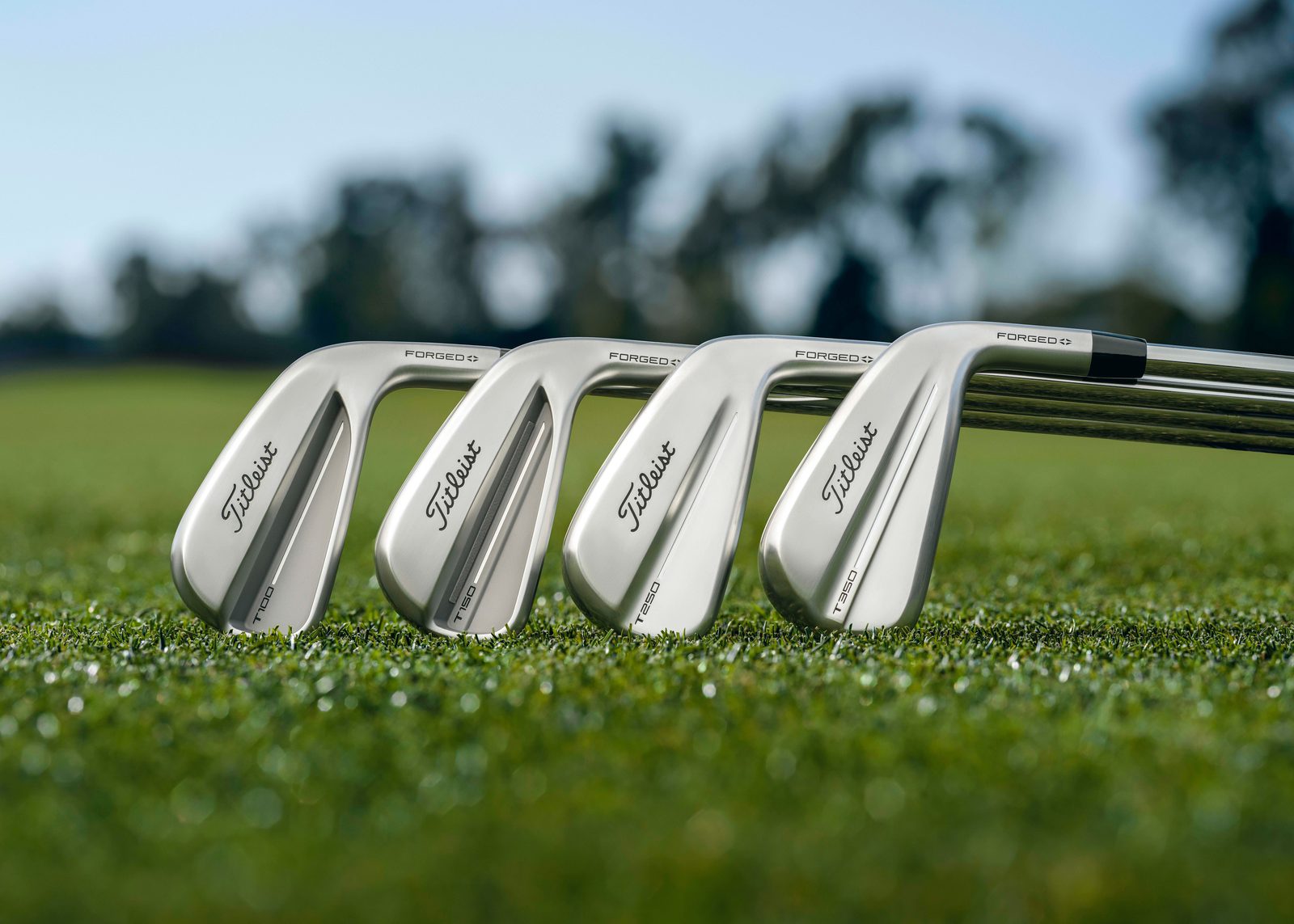
The 2025 T-Series lineup. Image from the Titleist media center.
| Club | T100 | T150 | T250 | T350 |
|---|---|---|---|---|
| 4 | 23° | 22° | 22° | 20° |
| 5 | 26° | 25° | 24° | 23° |
| 6 | 29° | 28° | 27° | 26° |
| 7 | 33° | 32° | 30.5° | 29° |
| 8 | 37° | 36° | 34.5° | 33° |
| 9 | 41° | 40° | 38.5° | 38° |
| P | 45° | 44° | 43° | 43° |
| W | 49° | 48° | 48° | 48° |
Source: Titleist, retrieved 2026-08-29. That page carries one loft table covering all four 2025 models, which is where every column above comes from. T250 also offers a 2-iron at 18° and a 3-iron at 20°. T350 adds a second wedge at 53°.
What each one is:
- T100. Fully forged, solid body, dual cavity, smallest head and least offset in the range. Titleist calls it the most played iron model on the PGA Tour, which is the company’s own claim rather than independent data.
- T150. The same forged construction, the same blade length and the same offset as T100, with a slightly larger, more forgiving head. One degree stronger than T100 in the 2025 sets, two degrees stronger in the 2023 set. It replaced T100S in 2023, and T100S held the same two degree relationship before it.
- T250. Hollow body with a forged face insert, and a slightly longer blade than T100. New for 2025, replacing T200, with an all steel chassis in place of the polymer badge T200 carried.
- T350. Titleist positions this as the most forgiving in the range. Larger head, wider sole, deeper center of gravity.
The lofts drift stronger as you move right, but that is a consequence of the category rather than a performance claim. A T350 7-iron at 29° is not four degrees better than a T100 7-iron at 33°. It’s a different club that happens to be numbered the same way.
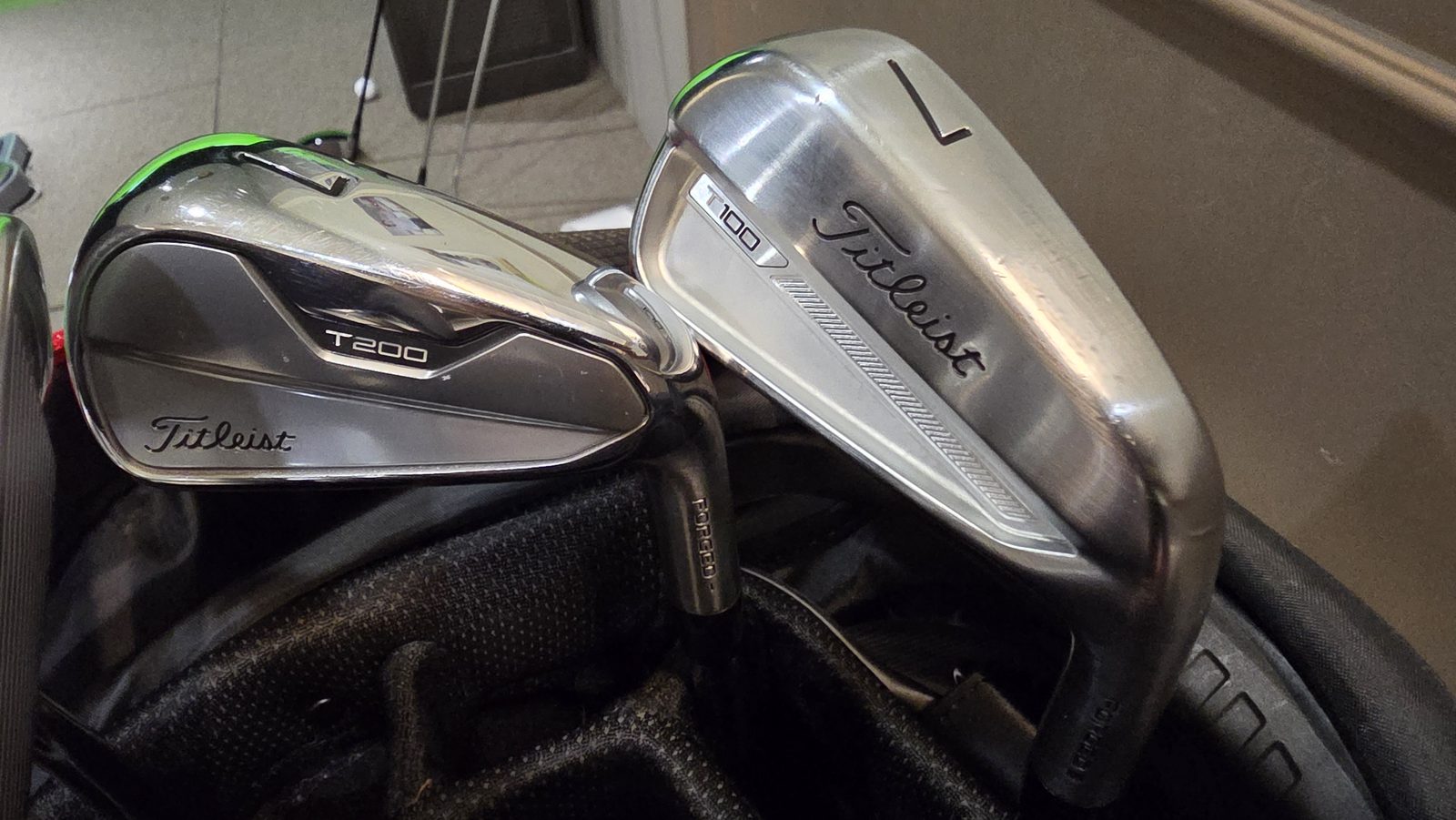
A friend’s T200 next to my T100, photographed with their permission. The head size difference is easier to judge here than in any spec table.
The gap between T100 and T150 halved in 2025
This is the part I didn’t expect to find, and I haven’t seen it written down anywhere.
For three releases, T150 and its predecessor T100S were defined by a fixed relationship: exactly two degrees stronger than the T100 of the same year. Titleist said so in its own launch material, describing T150 as having “2° stronger lofts compared to T100” (Titleist Newsroom, August 3, 2023).
Then 2025 moved T100 one degree stronger and left T150 where it was.
| Club | T100 2023 | T150 2023 | Gap | T100 2025 | T150 2025 | Gap |
|---|---|---|---|---|---|---|
| 5 | 27° | 25° | 2° | 26° | 25° | 1° |
| 7 | 34° | 32° | 2° | 33° | 32° | 1° |
| 9 | 42° | 40° | 2° | 41° | 40° | 1° |
| P | 46° | 44° | 2° | 45° | 44° | 1° |
Sources: Titleist spec tables for 2023 and 2025, retrieved 2026-08-29.
The table above shows four clubs. The pattern holds across the set. The full T150 column sits in the lineup table one section up, a degree under T100 at every position.
So a 2025 T150 7-iron at 32° and a 2025 T100 7-iron at 33° are close to the same club with different numbers on the sole. Same blade length, same offset.
The practical consequence is that choosing between them on 7-iron distance now tells you even less than it used to. What separates them is head size and forgiveness, not the number stamped on the bottom.
Who the T100 actually suits
Here the sources genuinely disagree, and that disagreement is worth seeing.
Titleist positions the T100 for players who value precise shotmaking. Golfalot’s 2025 review puts the target at a 0 to 5 handicap (Golfalot, July 10, 2025). Yet the benefit list on Titleist’s own product page includes “exceptional forgiveness in a Tour iron” (Titleist, retrieved 2026-08-29). Those two descriptions point at different buyers.
Both things can be true. The head is small and the offset is minimal, so the club shows you where you hit it. That feedback is the point. Whether it costs you shots depends on how consistently you find the middle, not on the number printed on your handicap card.
I’d frame the decision this way. The small head and minimal offset are what people buy the T100 for, and they’re also what makes a thin strike obvious. If that trade isn’t paying off for you, the T250 and T350 exist for a reason. Hitting all of them back to back in one session is what settled it for me.
Why I bought mine, and the gap the chart hides
I’d been playing a used Bridgestone V300 III for about six months. The T100 was my first set bought new, which is not the usual order of operations.
Honestly, looks started it. I thought the T100 head was the best looking thing in the shop, and the P790 was the only iron I found comparable. So I hit both.
The P790 didn’t feel right to me. That surprised me, because it’s the club most people rave about for feel. The T100 head looked too small and I nearly talked myself out of it. Then I hit it well, and that ended the argument.
I bought 5-iron through P. About a year later I added the 4-iron and a 50° W.
The 50° is the part I’d have wanted someone to explain to me first. Look back at the loft chart. From the 7-iron down, the T100 set steps by four degrees every time: 34, 38, 42, 46. The long irons step by three.
My wedges at the time were a Vokey SM10 52 and 56. So the bag went 46, then jumped six degrees to 52, then four to 56.
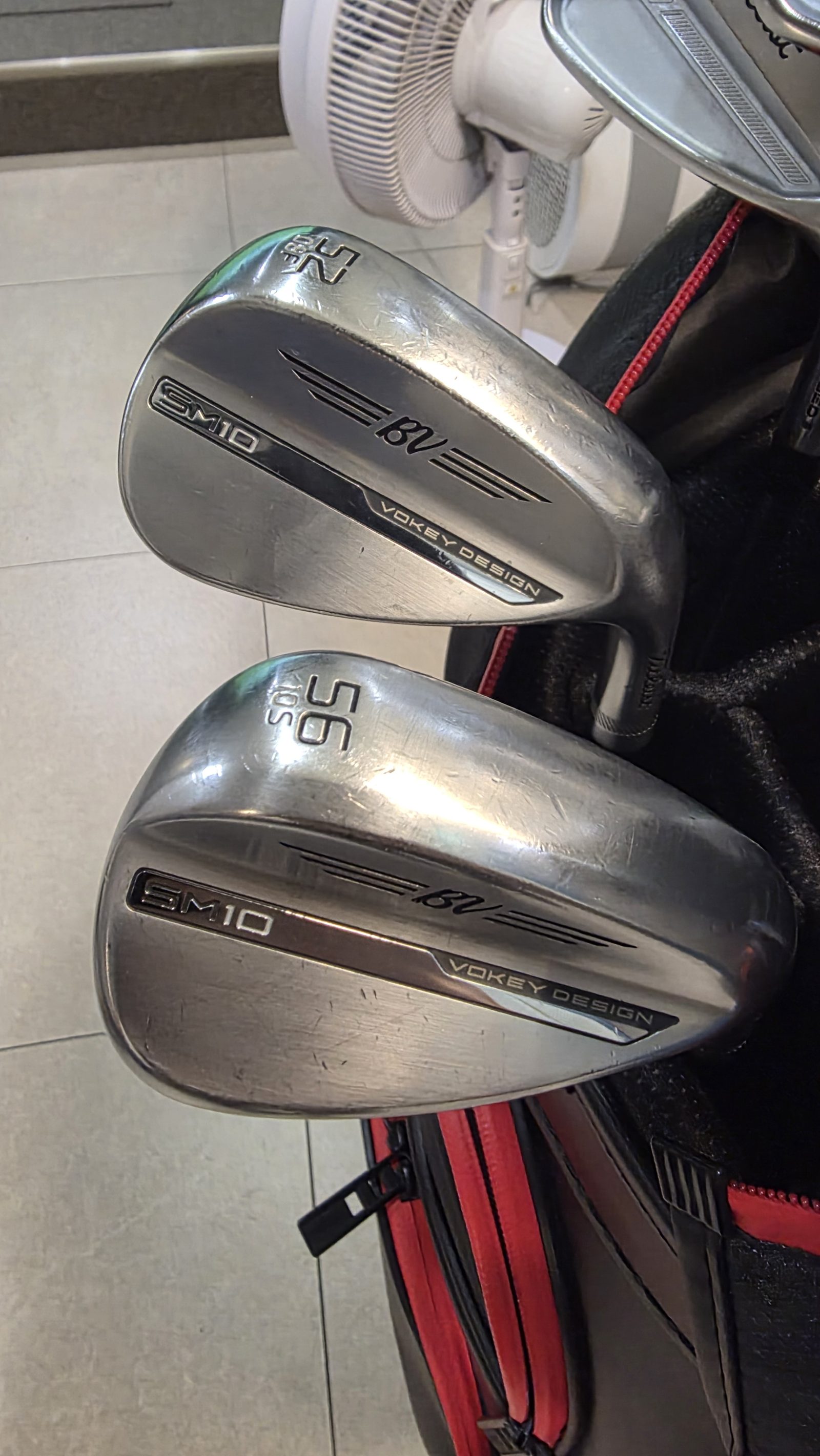
The wedges that created the problem: SM10 52.08F and 56.10S.
That six degree step is the widest gap anywhere in my irons and wedges, and it lands in the range I play approach shots from. Buying the T100 W at 50° closed it back to four.
I’ll be straight about the side effect. I kept the 52, so I now carry 50 and 52 two degrees apart, which is tighter than I’d have chosen on purpose. I haven’t decided which one leaves the bag. That is the honest state of it.
The general point survives my indecision. T100 lofts are weaker than the game improvement irons a lot of people move up from. The 2023 T200 P is 43° and the 2025 T350 P is also 43°, against 46° on the 2023 T100 (Titleist 2023, Titleist 2025, retrieved 2026-08-29). Carry the same wedges across that switch and your first gap gets three degrees wider without you choosing it.
I went through a similar amount of deliberation on shafts. That one needs its own post, so I’ve left it out here.
Frequently asked questions
How do I tell which T100 generation I have?
Read the P. A 46° P means 2019, 2021 or 2023. A 45° P means 2025. Separating the first three by loft alone is impossible, because they’re identical. The finish helps a little, since 2021 introduced the brushed chrome, but for a definitive answer you need the serial number and a Titleist dealer.
Can I mix T100 clubs from different years?
Within 2019, 2021 and 2023, the lofts and lengths match exactly, so a single replacement club slots in cleanly. Watch the lie angle if the club is a 2019 3-iron or 4-iron. Mixing a 2025 club into an older set leaves a one degree step where the two meet.
Is the 2025 T100 worth upgrading to from 2023?
Nothing in the numbers argues for it. The set moved one degree as a block, so your gapping stays the same and your carry numbers shift slightly. The construction changes in the long irons are the real argument, and those are worth testing rather than reading about.
Are T100 and T150 lofts the same?
No, but they’re closer than they used to be. In the 2025 sets T150 is one degree stronger than T100 in every club. In 2023 the gap was two degrees. It narrowed because T100 got stronger in 2025 and T150 did not.
What loft is the T100 pitching wedge?
46° for the 2019, 2021 and 2023 releases, and 45° for 2025. The matching gap wedge is 50° and 49° respectively.
What I’d tell someone looking this up
If you came here for a number, take the chart and go. The T100 has been a remarkably stable set of specs, and most of what gets written about generational differences describes construction rather than geometry.
If you’re choosing between models, the loft column is the least useful thing on the page. In the 2025 sets, comparing a T100 to a T150 by 7-iron carry is comparing 33° to 32°. What actually differs is how the head looks at address, how the sole moves through turf, and what a miss feels like.
And check the step below your P before you buy the wedges. That’s the one I got wrong.